Royal Albert Hotel

Built: 1880 / 1939
Address: 387 George Street
Architects: Louis Boldini / Stone & Sturmer
Builders: Norman Wood / D.P. Murphy

A Labour Day procession makes its way south along George Street, some time between 1892 and 1896. The Royal Albert Hotel can be seen on the right. The bay with the shop front at the left-hand end was added in 1882. (Hocken Collections S09-219e)

There has been a pub on the site of The Bog Irish Bar for nearly 150 years. In April 1864, James Ramage Hood was granted a license for a new public house named the Black Bull Hotel. An early photograph shows it was a single-storey wooden structure. Hood was succeeded as licensee by William and Margaret Carveth (from 1866 to 1877), and Johann Luks (1877-1879).

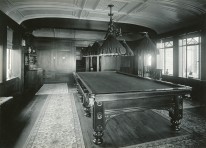
Luks was a German immigrant who had previously worked as a fruiterer in George Street. In late 1878 he commissioned the architect Louis Boldini to design a new hotel building, but was declared bankrupt in August 1879 before the project could go ahead. Daniel White purchased the fourteen-year lease on the property the same month, and in December was granted a license for the establishment which he gave a new name: the Royal Albert Hotel. The replacement building was erected in 1880 by contractor Norman Wood to Boldini’s plans, and completed by October. It was built of brick, with ornate cemented facades in the revived Italian Renaissance style, and made the most of a tricky triangular site. The ground floor had a bar, three sitting rooms, a dining room, and a kitchen. There were nine bedrooms and a sitting room on the first floor.

Louis Boldini was the only Italian or Continental European architect who worked in Dunedin in the late nineteenth century, and as most of his work has been destroyed this building is a significant survivor. Boldini’s most impressive designs included the second Dunedin Synagogue, the AMP Building, Butterworth Brothers’ warehouse, and the Grand Hotel. Of these only the Grand remains (as the Dunedin Casino within the Southern Cross Hotel).

Daniel White, first licensee of the Royal Albert Hotel (Toitū / Otago Settlers Museum, A566-1)

Daniel White (c.1834-1907), known to some as ‘Black Dan’, was born on the Caribbean Island of St Thomas. He arrived in Dunedin in 1859 and initially worked as a barman at the Provincial Hotel. After running a restaurant called the Epicurean, he opened the Crown Hotel at the intersection of Rattray and Maclaggan streets in 1862. He was later the founding proprietor of Royal Hotel in Great King Street, the Queen’s Hotel in Castle Street, and the Ravensbourne Hotel. He was also a West Harbour Borough councillor.

For many years White was one of the most respected publicans in Dunedin, but in 1882 he was refused a renewal of his license for the Royal Albert Hotel on grounds of ’immorality’. Separated from his wife of twenty years, he had fathered children by two of his servants, one of whom he had been found guilty of beating (for which he was fined one pound). He was forced to give up the Albert, but eventually returned to the Queen’s Hotel in 1888 and remained there for ten years. His last pub was the Duke of Edinburgh Hotel in Russell Street. White died in December 1907 at the age of 73.

The Albert passed to Francis O’Kane in 1882, and to Joseph Strong before the year was out. Building additions, again designed by Boldini, extended the hotel in a southwards direction. The next licensees were Robert Allen (1883-1889), Alfred Low (1889-1890), Mary Campbell (1890-1892), and Michael Maloney (1892-1896). The hotel was refurbished during Maloney’s time and alterations designed by architects Mason & Wales were carried out. Maloney was succeeded by John McLeod (1896-1900), Margaret Braun (1900-1904), Thomas Laurenson (1904-1907), Robert McClintock (1907), George McGavin (1907-1911), Michael Cahill (1911-1912), Eliza Cahill (1912-1918), and Sarah Laurenson (1918-1928).

Advertisement from the New Zealand Tablet, 4 November 1892 p.24 (Papers Past, National Library of New Zealand)

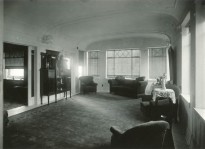
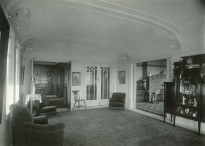
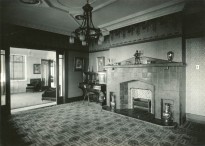
The longest serving publican of the Royal Albert Hotel was Henry Mathie Allan, who ran the business from 1928 to 1961 together with his wife, Frances Annie Allan. Above the corner entrance can still be seen the words: ‘H.M. Allan, Licensed to Sell Fermented & Spirituous Liquors’. This wording was uncovered when layers of paint were stripped from the fanlight in 2007. Harry Allan was the son of Eliza Cahill, one of the earlier licensees. He had a keen interest in trotting and owned a number of horses, the most successful of which were Blue Horizon and Will Cary. In Allan’s time the hotel underwent its most radical transformation. The architects Stone & Sturmer (Gorton R. Stone and Frank Sturmer) were commissioned to design extensive internal alterations, a large extension facing London Street, and an art deco makeover of the old exterior. The work was carried out in 1939 by D.P. Murphy and cost £5,443. Stone & Sturmer reworked a number of other nineteenth-century facades in Dunedin during the 1930s, including the Victoria Hotel in St Andrew Street (since demolished) and the Victoria Chambers in Crawford Street. As with Mandeno & Fraser’s remodelling of the Manchester Unity Chambers, previously discussed in this blog, the final result is a marriage of two styles and periods.

Perspective drawing by Stone & Sturmer, architects (Evening Star, 21 March 1939 p.3, with thanks to Dunedin Public Libraries)

Perspective drawing by Stone & Sturmer, architects (Evening Star, 21 March 1939 p.3, with thanks to Dunedin Public Libraries)

An Evening Star newspaper report stated: ‘The exterior of the building will be changed to suit present-day tastes with coloured plaster ornaments rising from a brown-tiled base’. Boldini’s ornamentation was removed and plastered over, but the first floor window openings remained and the building retained much of its original rhythm and some of its Victorian character. The new decoration included fluting, floral motifs, and string courses with scroll patterns. Leadlight windows were installed in the first floor and for the fanlights. The ground floor windows were enlarged but mostly filled with glass bricks, the idea being to let light in but keep noise out and the temperature stable. The new private bar was ‘modern to the extreme with colours of black, red, cream, and chromium predominating in a design of sweeping curves and horizontal lines’. It featured a 100-foot continuous counter. The London Street additions were likewise modern in style, with a flat-roofed building erected over the old yard space.

The building in 1983, photographed by Frank Tod (Hocken Collections S13-531a)

The building in 1983, photographed by Frank Tod (Hocken Collections S13-531b)

Edward and Lindsay Young bought the hotel 1963 and remained the licensees to 1977. They gave up the accommodation side of the business and in 1971 the London Lounge bistro opened on the first floor, taking space previously used for bedrooms. A New Zealand Breweries publication reported: ‘The decor shows foresight and courage: a challenging psychedelic (cloth) wallpaper, brightly-hued lampshades, vari-coloured seats, [and] contrasting drapes’.  A tavern license was issued in 1978 when the Royal Albert Hotel became the Royal Albert Tavern.

The next big makeover came after Michael Bankier bought the tavern in 1988. The Royal Albert was renamed the Albert Arms and given a Scottish theme, complete with Royal Stuart tartan carpet. The menu included ‘Kildonald Fried Chicken’, ‘Loch Lomond Salmon Salad’ and ‘Isle of Orkney Pork Chops’. Loch Lomond is not known for its salmon, nor Orkney for its pigs, but the names were only intended to be fun. The ground floor windows were reglazed to allow patrons to watch what is one of Dunedin’s most buzzing street corners, and the exterior was repainted in a distinctive green and red colour scheme selected by Peter Johnstone and Sue Medary of the Design Consultancy. The refurbished bar and restaurant opened in June 1989.

The green and red colour scheme of 1989-2007, photographed  by Axel Magard in 2000.

The green and red colour scheme of 1989-2007, photographed by Axel Magard in 2000 (Creative Commons license)

For a short period from 2004 the Albert Arms returned to the ‘Royal Albert’ name and the bar was branded as Albie’s, but the large Albert Arms sign remained on the parapet. The most recent refurbishment came in 2007, when the Royal Albert became The Bog Irish Bar, one of a chain of four bars in Auckland, Christchurch, and Dunedin. The exterior was repainted blue, with gold and grey detailing. The London Lounge closed but a new restaurant was later opened in the space. Steel grilles were added in front of four first floor windows and a variety of textured and coloured glass panes installed in the existing ground floor windows. There are many appealing features,  but to me it’s a pity that the old name has gone and there is no celebration of the site’s own 149-year history amidst the large amount of generic Irish history that decorates the interior.

There is a curiosity in the exterior plasterwork in that two dates, 1859 and 1939, are engraved on the parapet. The second commemorates the rebuilding, but the first is something of a mystery. The original 1880 decoration also featured the 1859 date. The site was first licensed in 1864, so is the reference to 1859 a mistake? Was Dan White referring to the year he first arrived in Dunedin? Or was there some other business on the site from this date? It’s something to ponder – perhaps over a beer!

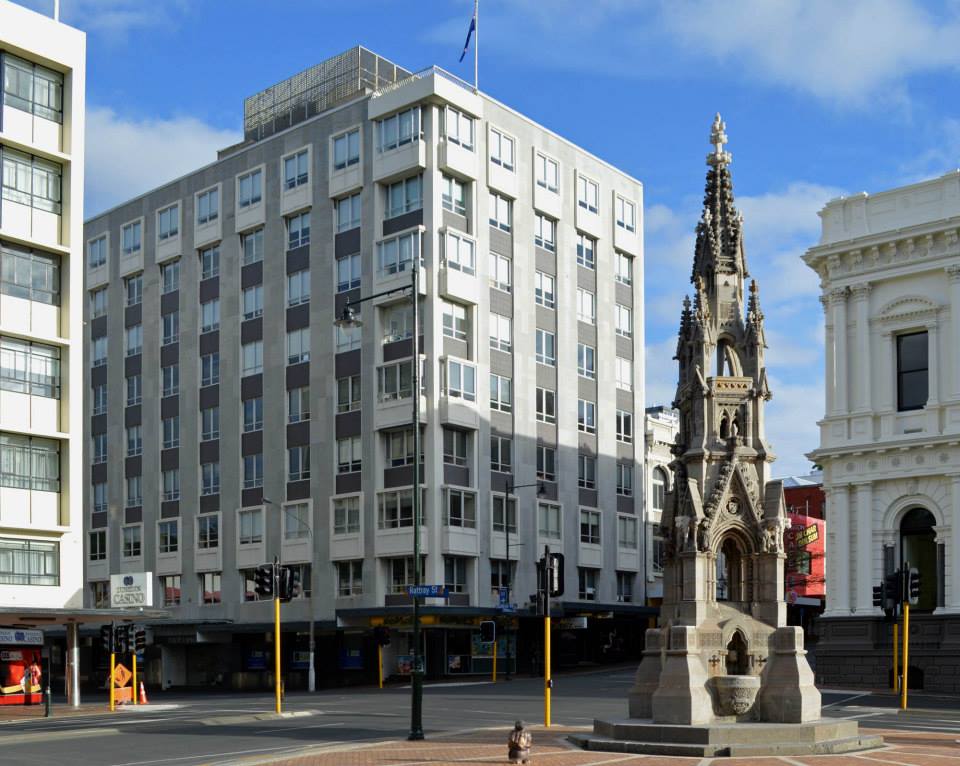
The building in 2013

View from London Street, showing the 1939 additions on the right

Detail featuring the ‘Royal Albert Hotel’ name and the dates 1859 and 1939

Leadlight window with the name of Harry Allan, licensee from 1928 to 1961

Newspaper references: Otago Daily Times, 20 April 1864 p.4 (Black Bull Hotel), 15 June 1864 p.4 (Black Bull Hotel), 12 August 1879 p.1 (bankruptcy of Luks), 23 August 1879 p.4 (sale of hotel), 3 December 1879 p.3 (transfer of license), 13 May 1880 p.2 (White in City Police Court), 5 October 1880 p.2 (description of new building), 19 June 1882 p.2 (White’s license), 25 July 1882 p.2 (additions),  3 April 1894 p.3 (alterations by Mason & Wales), 23 March 1911 p.12 (‘Black Dan’), 25 March 1961 p.2 (hotel sold), 19 June 1961 p.3 (retirement of Harry Allan), 14 June 1989 p.21 (refurbished as Albert Arms), 24 May 2007 p.10 (refurbished as The Bog Irish Bar), 18 October 2007 p.22 (The Bog); Evening Star, 31 December 1878 p.1 (call for tenders), 31 July 1882 p.2 (additions), 21 March 1939 p.3 (description of rebuilding); Otago Witness, 6 September 1879 p.15 (sale of hotel).

Other references: Dunedin City Council permit records and deposited plans; Frank Tod, Pubs Galore (Dunedin, 1984); Frank Tod papers, Hocken Collections (MS-3290/049).

Dresden Building (Capitol Building)

Built: 1912-1913
Address: 67-69 Princes Street
Architects: Salmond & Vanes
Builder: G. Lawrence & Sons

At the end of the nineteenth century there were two big music firms in New Zealand: Charles Begg & Co. and ‘The Dresden’. The head offices and showrooms of these businesses were right next door to each other in Princes Street.

The Dresden Pianoforte Manufacturing & Agency Company had been established by David Theomin and Frederick Michaelis in 1883, in part of an older block of buildings designed by David Ross and built in 1867. These premises, between the Octagon and Moray Place in Princes Street, included a music warehouse (for sale of instruments, sheet music etc.), piano and organ showrooms, piano manufacturing workshops, a concert room, and rooms for professional music teachers. The company claimed that its Dunedin premises alone never held fewer than 200 to 250 large instruments, such as pianos, organs, and harmoniums. The company’s innovative hire purchase scheme was hugely successful, and by 1907 the Dresden had 258 employees, and branches or agencies in 60 towns throughout New Zealand.

A contract for the erection of a new seven-storey building designed by Salmond & Vanes was signed on 17 February 1912. The site was immediately to the south of the old one, where two other buildings from Ross’s 1867 block were demolished. The old Dresden premises (facelifted in the 1940s) survive today and are occupied by Moray Gallery and Toast Bar. Salmond & Vanes’ records in the Hocken Collections include two sketch drawings which show some of the evolution of the design. They are for buildings one storey lower than the final design, apparently on the original site, and one features striking half-timbered gables in Tudor style. Because of the fall of the land, two of the levels would be built below the street.

Hocken Collections MS-3821

The total cost of the building was £18,504, putting it among the most expensive erected in Dunedin in the first two decades of the twentieth century. £1,000 was spent on tiling alone, with the exterior decorated with yellow and black Faience tiles manufactured by the Leeds Fireclay Company (Burmantofts Pottery). Yellow and black were the Dresden company colours. The overall style was a mixture Tudor Revival and Art Nouveau styles with three three-storeyed oriel window bays, and arched window openings on the top floor. The building is one of the city’s earliest examples of reinforced concrete construction; and steel framing for the frontage included a 10-tonne girder manufactured by A. & T. Burt, reported to be the largest girder put into a Dunedin building up to that time. It was also among the tallest buildings in the city, with the hill it was built on giving it a higher total elevation than the larger New Zealand Express Company building in Bond Street. The builders were G. Lawrence & Sons, with Turnbull & Jones contracted for the electrical work and George Davies & Co. for the heating. Completion of the work was recorded by the architects on 20 June 1913.

In 1912 the piano was at the peak of its popularity in New Zealand, with more pianos imported that year than in any other before or since. Annual imports had increased gradually from 1,200 in 1878 to 5,700 in 1912. Most were German, but the First World War soon changed that. In 1915 the Dresden Piano Company changed its name to the Bristol Piano Company ‘for reasons which will be obvious to patriotic citizens’. There is evidence of real prejudice against the firm and its owners. A correspondent from Gisborne wrote to the sensationalist Truth newspaper complaining that Theomin was German, favoured German products, and employed Germans in influential positions. The paper defended the company’s founder, explaining that he was born in England and was the son of a Prussian Jew. The firm’s new name was taken from Theomin’s birthplace: Bristol. Other German or German-sounding names were changed during the war or shortly afterwards. The Dunedin Liedertafel became the Royal Dunedin Male Choir, Brunswick Street in South Dunedin became Loyalty Street, and members of the Hallenstein family altered their name to Halsted.

An advertisement which appeared in the Evening Star, 2 January 1915, explaining the name change.

Examples of sheet music written by Dunedin musicians and published by the Bristol Piano Company: ‘British Boys’ (1915) and ‘Tropical Moon’ (1930)

The Bristol Piano Company building was a hub of musical activity in the 1920s and even had its own concert chamber, but the depression, new forms of entertainment, and declining sales of pianos, were hard on the company. In 1933 the Dunedin building was sold to a syndicate of Dunedin businessmen and rebuilt as shops and professional offices. It was noted at this time that a stone wall constructed by convict labour in 1862 could still be seen in the basement. The building was renamed the Capitol Building and is still known by that name. The Bristol Piano Company moved to Dowling Street and ceased trading in Dunedin in 1936. The national company went into liquidation in 1938. A later music firm in Dunedin called the Bristol Piano Company was a separate entity.

Occupants of offices in the building have included lawyers, doctors, and dentists. In the early years many of the rooms were taken by music teachers and the Barth School of Music (1921-1972) were long-standing tenants. This school was run by three sisters: Beatrice, Irene, and Ruby. They had a room each on the fourth floor for individual lessons, and there was a classroom where they taught theory to the younger pupils and hosted meetings. They were leading members of the Society of Women Musicians of Otago, and Beatrice administered the Dunedin Centre of Trinity College of Music.

A photography studio designed by the architects Miller & White was added above the existing top storey of the building in 1933. This was originally occupied by the photographer J.J. Webster, and in 1954 was taken over by Campbell Photography, which continued there to 1986. The lawyers Albert Alloo and Sons are now the longest-standing occupants of the building.

Much of the façade detail has been destroyed or covered over, including decorative tilework, parapet railings and detailing, and capitals. The arched window openings on the fourth floor have been replaced with square ones. The essential form of the building remains unchanged, however, and the original window joinery of the oriel windows is also mostly intact. Maybe it will return to the yellow and black Dresden colours one day. For nearly 60 years the building was much higher than its neighbours, until Evan Parry House was built on the site of the Bristol’s old rivals, Begg’s. It still makes a strong statement today, being tall and imposing among a collection of mostly lower buildings, and bringing variety to the streetscape.

Newspaper references: Otago Daily Times, 17 April 1867 p.1 (erection of old building), 23 April 1900 p.4 (about the company), 1 September 1909 p.3 (about the company), 22 August 1912 p.6 (new building); Otago Witness 18 May 1867 p.11 (old building); Grey River Argus, 7 January 1915 p.5 (name change); N.Z. Truth, 10 April 1915 p.7 (Theomin and Germany); Evening Star, 31 May 1933 p.3 (image and reference to wall). All references except the Evening Star sourced from Papers Past, National Library of New Zealand.

Other references: Dalziel Architects records, Hocken Collections (MS-2758/0727); Salmond Anderson Architects records, Hocken Collections (MS-3821); Stone’s and Wise’s directories; Suzanne Court, ‘Barth, Beatrice Mary’ from Dictionary of New Zealand Biography.

Temperance Hall (The Choral Hall)

Built: 1873-1874
Address: 21-27 Moray Place
Architect: Robert Forrest
Builder: James Gore

An early lithograph of the Temperance Hall (Toitū / Otago Settlers Museum)

This post continues the theme of public halls with the Oxford Buildings, known originally as the Temperance Hall and later as the Choral Hall. Completed in 1874, this venue was erected for the Dunedin Temperance Hall Company, a group formed chiefly by members of the Pioneer Lodge of the Temperance Order of Good Templars. The building was intended for the use of various local temperance groups, which were then part of a large, vigorous, and influential movement. They aimed to fight what one local clergyman described as ‘great evils arising from intoxicating drinks’. The hall was also available for general hire.

On the ground floor were offices and the ‘lower hall’ or meeting room, which measured 25 x 41 feet. On the first floor was the larger ‘upper hall’, which measured 72 x 43 feet and contained sitting room for 750 people. This hall had a stage and gallery and an ‘elliptical cove’ ceiling of varnished kauri with sunlights of stained glass. Kauri timber was used throughout the building. The facade was designed in a simple Renaissance Revival style, with rustication and round-headed windows on the ground floor, and curved and triangular pediments above the windows on the first floor. The building was described in the Otago Daily Times as being of a ‘plain but substantial character’.

The architect was Robert Forrest and the hall was one of his early works in his transition from the role of building contractor to the role of architect. The building has been mistaken for a William Mason design due to confusion with an unrealised theatre project that G.R. West put forward for a nearby site around the same time. The builder was James Gore, who submitted a tender of £2,778. The foundation stone was laid by the Mayor, Andrew Mercer, on 26 December 1873, following a procession in which 1,200 people took part. A bottle placed in the stone contained a scroll signed by officers of various lodges, newspapers, coins, and a company prospectus. The building officially opened with a soiree, concert, and dance, on 14 August 1874.

Otago Daily Times, 11 March 1878 p.1 (from Papers Past)

For decades, balls were held (the floors were designed with this in mind), dancing lessons given, and many concerts and other entertainments put on. The Kennedy Family were among the first to appear in the hall with their performances of popular Scottish ballads in 1874. The world billiards champion John Roberts played here in 1876, and the tight-rope walker Henry Morris (‘The New Zealand Blondin’) performed in 1878. A waxwork exhibition featured likenesses of the Kelly Gang and other famous people. One series of chamber music concerts was organised by Raphael Squarise and Arthur Barmeyer through their Otago Conservatorio of Music. A four-day Maori Carnival was held 1902.

Religious meetings were held in the building for nearly 40 years. The Salvation Army’s first New Zealand meetings were held at the hall on 1 April 1883, both preceding and following the better-known outdoor gathering commemorated by a brass plaque on Cargill’s Monument. The Army continued to use the hall for three years. From 1886 the Open Brethren hired it, and it was at this time that the name of the building was changed from the Temperance Hall to the Choral Hall. The Brethren were led by the evangelist Alfred Brunton, who had earlier preached at Farley’s Hall. He led Brunton’s Choir, a group of up to 100 singers hat was known throughout Otago, favouring the new style of emotional (and sometimes sentimental) Moody and Sankey songs. This ministry through music may explain the adoption of the Choral Hall name. Brunton died in 1900 and the Brethren continued to hold their meetings in the hall until 1920, when they moved to a new building.

Many clubs and societies met in the Choral Hall. The Dunedin Burns Club held meetings and gave concerts, and from 1891 to 1906 the Otago Art Society held its annual exhibitions in the building. Frances Hodgkins, then just beginning her career, was among those who exhibited. There were also many political meetings and lectures, the latter including such topics as ‘Reincarnation as a Factor in Evolution’ (by a theosophist) and ’Eighteen Months in the Canadian Far North’ (for the Otago Institute).

11 July 1889 was a significant day in the history of New Zealand. The inaugural meeting of the country’s first women’s union, the Tailoresses’ Union, was held at the Choral Hall and Rev. Rutherford Waddell gave what became a famous speech denouncing working conditions and ‘sweated labour’ in factories. This broke the sweating scandal that led to the Sweating Commission of 1890, which was in turn instrumental in the passing of the Factories Act and other legislation by a new Liberal Government.

Otago Daily Times, 14 July 1890 p.1 (from Papers Past)

The Women’s Christian Temperance Union (WCTU) met in the hall and the Women’s Franchise League of New Zealand grew out of this, holding it’s inaugural meeting at the Choral Hall on 28 April 1892. This group played a pivotal role in promoting women’s suffrage and widely circulated the petition that was so influential in the successful campaign for women to be given the vote.

In the early 1920s the first-floor hall was converted to a clothing factory for Butterworth Brothers, who employed about 40 staff on the premises, putting their robe department in the gallery and machinists on the main floor. A fire broke out on 16 March 1927, the same day that thousands of people gathered in the streets for the visit of the Duke and Duchess of York. The blaze extensively damaged the first floor and roof, but the ground floor (where the auctioneer Spedding used the old lower hall) escaped with little more than water damage. The building was rebuilt, but the panelling that can be seen in the hall today suggests that the polished kauri ceiling was lost. The space was later used by Sharland & Co. (wholesale druggists) and the Dunedin Frock Manufacturing Company.

ChoralHall

The Temperance Hall Company sold the building as early as 1882, due to debt and the difficulty of competing with newer halls. In the late nineteenth century it was owned by D.C. Cameron and in the early twentieth century it passed to the Taylor Trustees. In 1932 they employed the architects Miller & White to design extensive alterations to the building which were carried out by the Glue Construction Company at a cost of £2,500. This saw the removal of the lower hall and the building of three shops on the ground floor. A new verandah used Wunderlich pressed metal, while shop fronts featured Australian rose mahogany woodwork, decorative leadlights, and orange and black terrazzo slabs. This work was described in the Evening Star as being in ‘ultra-modern style’. The main staircase was rebuilt in a new location and a lift installed by Turnbull & Jones, for which a small penthouse was added to the roof. The first floor facade decoration seems to have been left unaltered at this time, but in 1944 it was stripped of its ornamentation and given a plainer style that was then fashionable. A new name, ’Oxford Buildings’, was added to the parapet in relief lettering.

The auctioneers Spedding’s (succeeded by Scandrett’s) took one of the shops. Eliza Squire (a milliner and seamstress) occupied the middle one from 1939 and remained there for twenty years. The other shop, at 25 Moray Place, was occupied by Modern Books from 1943 to 1954. This was run by the Dunedin Co-Operative Book Society (one of just a few bookshop co-operatives in New Zealand), which had socialist ideals and aimed ‘to foster the reading and writing and production of books, pamphlets, circulars and other publications of a nature that will promote an active and intelligent interest in progressive ideas and activities’. The shop specialised in New Zealand books, history, music,and philosophy, as well as general literature. Landfall editor Charles Brasch was involved with the management and day-to-day running of the shop, which was frequented by the local literati. Janet Frame sometimes browsed there in its last year or so, hoping to ‘glimpse one of the literary figures of Dunedin or one visiting from up north’. From roughly 1956 to 1976 the same shop was occupied by Catholic Supplies.

The old upper hall became the Manhattan Lounge in 1960. The space remained essentially unchanged but the old gallery became a bar (originally a coffee bar) with a dance area on the floor below. The Lounge was a popular venue up to the 1980s, and later became the Manhattan Theatre. At the time of writing it is used by the Vertical Aerial Dance studio, which offers specialist pole dancing classes. The shops are now occupied by Modern Miss (vintage clothing), and Whiteroom (sellers of designware, furniture, lighting, and contemporary art). The building looks well kept but the grey exterior colour scheme is a little at odds with the warm colours of the terrazzo.

A lot more could be included in the story of this building. In pulling together various strands I’ve been impressed by the national significance of its social and cultural history. It’s a frequently overlooked treasure, easily worthy of registration as a category I historic place.

OxfordBuildings_shops

ChoralDetail1

Newspaper references: Otago Daily Times, 25 March 1873 p.2 (meeting for proposed hall), 14 April 1873 p.2 (meeting – site put forward), 17 May 1873 p.2 (formation of company), 14 August 1873 p.3 (West’s proposed hall), 27 November 1873 p.4 (tender accepted), 17 January 1874 p.2 (Rev. James Clark on alcohol), 21 January 1874 p.6 (laying of foundation stone), 26 June 1874 p.2 (progress), 7 August 1874 p.3 (description – nearing completion), 15 August 1874 p.2 (opening and description), 21 August 1874 p.2 (finishing touches), 29 August 1874 p.8 (description), 18 September 1876 p.3 (John Roberts, billiards champion), 25 August 1882 p.3 (buildings to be sold), 28 September 1882 p.2 (sale), 27 June 1883 p.3 (lease to Salvation Army), 8 June 1889 p.2 (Sweating Scandal meeting), 29 April 1892 p.3 (Women’s Franchise League meeting), 5 July 1920 p.4 (Open Brethren move out), 17 March 1927 p.10 (fire), 18 March 1927 p.13 (fire); Evening Star, 17 March 1927 p.6 (fire), 20 September 1932 p.2 (alterations), 24 January 1933 p.1 (alterations).

Other references: Stone’s Otago and Southland Directory; Wise’s New Zealand Post Office Directory; telephone directories; Dunedin City Council permit records and deposited plans; Barrowman, Rachel, A Popular Vision: The Arts and the Left in New Zealand (Wellington, 1991) pp.125-127; Frame, Janet, An Angel at My Table (New York, 1985) pp.126-129; Stacpoole, John, William Mason: The First New Zealand Architect (Auckland, 1971); Hocken Collections MS-2758/0288 (Miller & White plans)

Farley’s Buildings

Built: 1863
Address: 118-146 Princes Street
Architect: Charles G. Smith
Builder: Not identified

These buildings may be scruffy and disfigured, but they’re among the richest sites of social and cultural history in Dunedin, which makes them more exciting than many structures with grand porticos or pretty turrets. They are also among the very oldest commercial buildings in the city.

Farley’s Buildings were erected for Henry Farley (c.1824-1880), a colourful entrepreneur whose business ventures in Dunedin included the Vauxhall Pleasure Gardens and Farley’s Arcade (later redeveloped as Broadway). The brick buildings with stone foundations were erected between July and November 1863, and a report in the Daily Telegraph told readers: ‘Mr C.G. Smith is the architect of this very comprehensive pile of buildings, and its design, as a specimen of architecture, is extremely creditable to him’. Not much is known about Charles Smith, but he designed Dunedin’s Theatre Royal (1862), and claimed to have designed theatres in Sydney and San Francisco. He later worked on the West Coast.

Most of the buildings in Princes Street at this time were timber constructions, so Farley’s Buildings represented striking progress at a time when fires were frequent and gold rush money was still only beginning to make an impact. The buildings originally had unrendered brick facades but photographs show that the upper brickwork deteriorated quickly. By 1874 it had been plastered over, although decorative details (including cornices and window surrounds) were preserved in rendered form, and the name ‘Farley’s Buildings’ was added to the parapet in relief lettering. Small additions with windows to Dowling Street were made around the late 1880s, when the street was reformed.

A Daniel Mundy photograph of the buildings taken in 1864, just a few months after they were built (Toitū / Otago Settlers Museum, Album 54)

A photograph taken around 1870 (Toitū / Otago Settlers Museum 57-98-1)

Part of a Burton Brothers panorama from 1874, showing the plastering of the brickwork.

The original block of buildings was the present 126-146 Princes Street. It included five ground-floor shops, upstairs offices, a music/assembly hall, and a photography studio. The studio was in the portion that rises above the Dowling street corner. It was taken by Tait Brothers (Royal Caledonian Photographic Rooms) in late 1863 or early 1864. Later photographers here included Henry Frith, John McGregor (Edinburgh Portrait Rooms), John Gittins Wills (American Photo Company), and Charles Clarke Armstrong. The artist Max Walker had a studio and flat here from 1940 to 1942. He was one of Dunedin’s most out-of-the-closet gay men (at a time when homosexuality was illegal) and was known for his riotous parties. His lease ended after a visit from a particularly rowdy group Norwegian sailors.

The assembly or concert room originally housed the Dunedin Music Hall, soon better known as Farley’s Hall, which was housed under the high roof structure that can still be seen at the northern end of the buildings. It measured 65 feet by 26 feet and was 16 feet high. Events held in the 1860s included balls, dance classes, bazaars, banquets, Nicholas Chevalier’s art exhibition, a wax works display from Madame Sohier’s in Melbourne,  and Mr Hamilton’s practical phrenology demonstrations which included the examination of ‘Living heads of noted men of Dunedin’.  The hall could only hold about 300, so larger new venues were soon favoured for popular entertainments.

An advertisement for one of the lectures of Mrs Charles Fanshawe Evereste (Alice Marryat). Otago Daily Times 5 December 1864 p.6 (Papers Past, National Library of New Zealand)

There were many political meetings: Julius Vogel spoke here as did supporters of James MacAndrew prior to his re-election as Superintendent in 1867. The Otago Provincial Council used the hall as its chambers from 1864 to 1866 (prior to completion of the Provincial Government Buildings), making the buildings a significant site of government in the heady gold rush years. The many other gatherings in the hall took in meetings of company directors, lodges, interest groups, and societies, including the Acclimatisation Society, Caledonian Society, Horticultural Society, Athenaeum and Mechanics Institute, and the Benevolent Institution (which also had offices in the buildings).

The hall was regularly used for religious meetings, notably the Brethren services led by evangelist Alfred Brunton, who was said to have been the first to introduce the colourful Moody and Sankey choruses to Dunedin. One of Brunton’s famous converts was the bush ranger Henry Garrett, who in 1868 became a member of the congregation but brought much embarassment on them by burgling the chemist shop below. Brunton’s group moved to the Garrison Hall in 1879 but another group continued to meet in Farley’s Hall up to 1900.

Upstairs rooms were set up as offices with the first tenant being the barrister and solicitor G.E. Barton. Thomas Bracken of the Saturday Advertiser had rooms in the building in 1878, but so far I haven’t been able to confirm if he was there in 1876, when he ran a competition to set to music his verses ‘God Defend New Zealand’. It’s possible the words were written here. Other tenants in the nineteenth century included John Irvine (Dunedin’s first professional portrait painter), David Henderson (lithographer), Alfred Boot (dentist), John Hewitt (dentist), Alexander Hunter (surgeon), Edmund Quick (consular agent), and Abraham Solomon (pawnbroker). Solomon, who was a leading member of the local Jewish community, purchased Farley’s Buildings around 1880 and permit records suggest at least part of the block remained in the ownership of the Solomon Estate in the 1930s.

The ground floor shops were originally let to Walsh Brothers (boot and shoe sellers), Thomas Collins (fruiterer and confectioner), McLeod & Gibson (grocers), and Ure & Co. (tea dealers and warehousemen). The remaining shop was subdivided for Thomas Bray (hatter and outfitter) and M. Jones. There have been so many businesses in these buildings since then that I won’t attempt to name them all, but some have had particularly long occupancies.

Stewart Dawson & Co., an Australian-based chain of jewellers still in Dunedin, occupied the corner premises from 1902 to 1979. They carried out major alterations before moving in, combining two shops into one, installing new shop fronts, and putting in compressed-steel wall and ceiling decoration made by the Wunderlich Company of Sydney. The colourful and brightly-lit interior was described in the Cylopedia of New Zealand as having the appearance of a fairy palace. The contractor was James Annand.

The shop of Stewart Dawson & Co. (Toitū / Otago Settlers Museum, 57-64-1)

A Muir & Moodie postcard, c.1905

A Muir & Moodie postcard, c.1905

Cookham House, a footwear store, occupied 132 Princes Street from 1904 and later moved to no. 122 before moving to George Street in 1984. It had been established by John Switzer on another Princes Street site in 1857, although it is unclear if the nineteenth-century history of the firm was continuous (Joseph McKay may have revived the name). Cookham House was associated with the tailors Hamel & McKenzie for many years and continues today in association with Bob Shepherd Menswear.

J.C. Gore Ltd, jewellers, went into business at 131 Princes Street in 1949 and moved across the road to Farley’s Buildings (no. 132) in 1962. The firm closed in 2005 but at the time of writing their old neon sign can still be seen above the verandah.

In October 1906 a fire destroyed the buildings of the New Zealand Bible, Tract, and Book Society, which stood to the north of Farley’s 1863 buildings. These buildings were also owned by Solomon, who replaced them with new additions to Farley’s Buildings that repeated the old facade decoration. James Annand was again the contractor. The Bible Depot remained there into the 1930s and the buildings are now the home of Disk Den, a music shop that was established by Russell and Alma Oaten in Rattray Street in 1958, and which has been on its present site since 1987. Some original decorative plaster ceilings can still be seen inside.

The buildings have seen many physical changes: bullnose verandahs running the length of the buildings were added in 1904 and replaced with hanging verandahs in the 1930s; the facades were re-plastered in the 1940s, when decorative detailing was removed and window openings altered; a large skylight above the hall was removed at some date, and more recently the photography studio has been entirely reclad. Despite these alterations the essential form of the buildings remains intact, and can be more readily seen and appreciated here than in any of Princes Street’s other surviving buildings of the 1860s (most of which are behind later facades). Farley’s Buildings are a rare link with the city’s early history and should be among its most prized heritage.

A photograph showing the roofs, with the former photographic studio at the far left and Farley’s Hall under the rusty roof at the centre.

Newspaper references:

Daily Telegraph, 31 October 1863 p.5 (description); Otago Daily Times, 28 May 1862 p.4 (Theatre Royal), 24 July 1863 p.3 (call for tenders for foundation), 1 August 1863 p.2 (call for tenders), 11 August 1863 p.6 (call for tenders – carpenters and joiners), 16 November 1863 p.10 (Thomas Collins advertisement), 21 November 1863 p.8 (Walsh Bros advertisement), 24 November 1863 p.3 (to let notice – offices), 7 December 1863 p.2 (advertisement for Dunedin Music Hall), 28 August 1865 p.5 (Provincial Council), 27 June 1867 p.1 (phrenology), 4 July 1867 p.1 (accommodation for 300 in hall), 4 March 1873 p.3 (Edinburgh Portrait Rooms), 12 December 1902 p.8 (Stewart Dawson alterations), 26 November 1906 p.3 (Bible Depot fire), 23 February 1907 p.12 (rebuilding), 26 November 1984 p.20 (Cookham House history), 31 July 2010 p.42 (Alfred Brunton); Otago Witness, 20 February 1863 p.4 (Tait Brothers advertisement).

Other references: 

Block plans (1889, 1892, 1927); Cyclopedia of New Zealand, vol.4 (Otago and Southland Provincial Districts) 1905; Stone’s, Wise’s and telephone directories; Dunedin City Council permit records and deposited plans; information supplied by Peter Entwisle (re Max Walker); Tonkin, Lance, The Real Henry Garrett.

McCarthy’s Buildings

Built: 1907
Address: Cr Stuart and Castle streets
Architect: Walden & Barton
Builders: G. Simpson & Co.

I’ve posted about a few Lower Stuart Street buildings now and there’s a reason why many of them are from the Edwardian period. The development of Lower Stuart Street progressed apace after the site of the new railway station was finally settled in 1902. It was obvious that a lot of foot traffic would soon be using the street, and it wasn’t long before modest wooden buildings disappeared and vacant sites were built on. Within about ten years a dozen substantial new buildings went up. This one was built for A. &. W. McCarthy Ltd, an old firm of gunsmiths, locksmiths, and fishing equipment specialists. Samuel McCarthy had set up business in Dunedin in 1861, originally as a gunsmith, locksmith, and bellhanger. Sam’s sons Arthur and Walter took over in 1890 and the firm then took on its familiar ‘A. & W.’ name.

An advertisement from the Otago Witness, 18 January 1894, p.44.

McCarthy’s new building went up in 1907. Tenders were called in February and the building was completed before the year was out, with the firm moving from their old premises at 65 Princes Street. The architects were Walden & Barton and the building pairs nicely with the Sweeting’s fish shop on the other side of Stuart Street, which they also designed in 1907. The architecture is a composite Edwardian style that draws from various periods, sometimes loosely called ‘Queen Anne’, and transitioning towards more modern styles. The building is large and handsome and on a prominent corner, yet somehow it manages to be unassuming. It’s sympathetic in scale and design with its grandiose neighbours, the Law Courts and the Railway Station. The gentle curves to the first-floor window surrounds are a nice touch, and pilasters, cornices, and recessed panels give interest to the facades. The pediment above the stairway entrance would have been more prominent before the hanging verandah was added. The building contractors were G. Simpson & Co.

McCarthy’s remained in the building for some 90 years but in its later years the shop itself was moved to the old dairy co-operative premises next door in Castle Street. Five generations of the family ran the business. They became the leading importer of English guns and increasingly specialised in fishing equipment. They were famous for their catalogue service (which even drew in overseas customers) and for a time they had branches in Invercargill and Palmerston North. They had shops and offices in the Stuart Street building, as well as workshops for their own manufacturing department. Children were paid to collect bags of cocoon bodies, which were used to make fishing lures. McCarthy’s fishing reels are now collectors items.

The shop kept a modest appearance and Cormac McCarthy recalled: ‘There were a lot of customers over on the West Coast who used to buy the mail order catalogues. They were often terribly disappointed when they got to Dunedin for the first time. They expected a place about three times as big as Arthur Barnett, with rows and rows of guns and fishing rods, and here was this little shop with an old bloke with a beard running around.’

Perhaps unusually for a gunsmith, Arthur McCarthy was a pacifist. He studied socialism and Marxism and opposed conscription during World War I. He was a labour movement activist and became national secretary of the United Labour Party in 1912, and later became involved in the Social Credit movement.  According to his grandson he had a reputation for having a fiery temper and giving firm advice. Caroline Martin recorded that ‘one of the more colourful stories about A.P. McCarthy involved prostitutes from the Railway Hotel next door who were in the habit of throwing their used unmentionables into the shared courtyard below’.

A. & W. McCarthy went into liquidation in 1999, by which time they claimed to be the oldest family-run business in Australasia. The firm’s stock and name were bought by Centrefire, which currently trades as Centrefire McCarthy’s in Moray Place. An immense accumulation of antique stock and memorabilia was sold by auction.

McCarthyDetail2

Many others have leased premises in McCarthy’s Buildings, which originally included six ground floor shops. The fruiterers, Steel’s, occupied the shop at 10 Stuart for 77 years from 1921 to 1988. Upstairs, an unarmed combat training school has occupied the building for the last 75 years.

Wrestling teacher and unarmed combat instructor Harry Baldock (1905-1991) moved to Dunedin in 1929 and opened a new gymnasium upstairs in the building in 1938. His school became known as the Baldock Institute. During the Second World War, Baldock was the New Zealand chief unarmed combat instructor and physical training instructor at Burnham camp as well as Forbury and Wingatui camps. He taught national wrestling champions and hosted many visiting international wrestlers. His wife, Iris, was a masseuse and physiotherapist who had worked as a nurse at convalescent hospitals for returned soldiers during the war.

In 1973 Geoff (‘Tank’) Todd began training at the Baldock Institute, initially in weight training, physical culture, wrestling, boxing, and Jiu Jitsu, and later unarmed combat. Todd took over the school in 1986 and it became Todd Group, which refocused towards unarmed combat. As of 2013, the group has an instructing team of over 100 instructors and 30 depots worldwide. It also operates a 280 acre 100-man accommodation training camp. Todd Group still runs a gymnasium at 6 Stuart Street. You can read more about their history on their website.

In 2005 the Stuart Street Potters Co-operative opened a gallery and shop at no.12. Koru Gallery arts co-operative occupies the corner shop.

The exterior of building has changed little apart from the addition of hanging verandahs in 1938. Even the original shop fronts remain; and inside, tongue-and-groove wall linings can still be seen. The building is currently owned by Allied Press.

McCarthyDetail

Newspaper references:

Otago Daily Times, 8 August 1906 p.8 (removal of old buildings), 18 February 1907 p.6 (call for tenders), 11 May 1907 p.12 (description), 24 December 1993 p.13 (‘In the family for 132 years’ by Caroline Martin), 18 May 1999 p.2 (McCarthy’s in liquidation), 18 June 1999 p.4 (Centrefire purchase), 24 June 1999 p.3 (McCarthy’s auction). Accessed from Papers Past (National Library of New Zealand).

Other references:

Colbert, Roy. ‘Generation Game’ in North and South, no.126 (September 1996), p.16; McCarthy, A.C. ‘McCarthy, Arthur Peter (1862-1947)’ in Southern People: A Dictionary of Otago-Southland Biography (Dunedin: Longacre Press, 1998), pp.293-294; 80 Years of Combative Excellence [DVD]. Dunedin: Todd Group, [2007]; Stone’s Otago and Southland Directory; Wise’s New Zealand Post Office Directory; telephone directories; Dunedin City Council permit records and deposited plans.

Lost Dunedin #3: Oriental Hotel

Built: 1863
Address: 152 Princes Street
Architect: [?] William Henry Clayton (1823-1877)
Builder: Not identified
Demolished 1887

Photo: D.L. Mundy, [1864]. Toitū / Otago Settlers Museum.

The Oriental Hotel was the most exuberant building of gold rush Dunedin. Dominating its neighbours, it magnificently thumbed its nose at any stodginess or dourness that might, fairly or unfairly, have been associated with the established settler society. The eccentric four-storeyed timber structure was built for John Sibbald in 1863, with construction reported as nearly complete by December that year. The following month Harriet Cooper was given a license to run the hotel.

The design of the Oriental was so eclectic that it has been variously described as Gothic, Continental, Renaissance, Old English, American and, yes, Oriental. It even had ironwork with shamrock motifs. The Otago Daily Times struggled to describe the building in 1864, but referred to it is as ’very pretty’ and an example of what might be termed  ‘Continental Gothic’, a departure from the ordinary Gothic style.  The great variety of detail included barley twist columns, grotesque heads, a representation of Bacchus, balcony stick work, Tudoresque chimneys, oriel windows, gablets, an elaborate and unusual cornice, and a platform with iron railings on the top of the building. No Asian influence was mentioned in the report and I haven’t found any evidence explaining whether or not the hotel name was chosen before or after the building was designed. Stacpoole and Beaven (1972) noted that the oriel windows with connecting balconies, along with the cornice, were ‘as far East as Gothic could go’.

A contextual view. Note the Dowling Street steps where the land was excavated in the 1880s allowing the extension of the street. Photo: 1865. Alexander Turnbull Library. Ref: PAColl-3824-04.

A contextual view. Note the Dowling Street steps where the land was excavated in the 1880s allowing the extension of the street. Photo: 1865. Alexander Turnbull Library. Ref: PAColl-3824-04.

The question of who designed the building has long been one of the puzzles of Dunedin’s architectural history. Some sources name Edward Rumsey as the architect, an attribution that seems to have originated with Stacpoole and Beaven (1972), based on stylistic grounds. Rumsey probably arrived in Dunedin aboard the Aldinga in June 1862, although he did not start advertising in local newspapers until August 1864. It is possible that he was the designer.

I have a new theory, which is that W.H. Clayton designed the building. Clayton worked in Dunedin from May 1863, and of all the architects working in Dunedin at the time he is the only one I know of whose style appears at all consistent with the Oriental. Clayton later became Colonial Architect and he designed many public buildings throughout the country, including the Old Government Buildings in Wellington. There are particularly striking similarities between the Oriental and his unrealised concept drawing for Government House in Wellington (c.1869). After searching newspapers online, on microfilm, and in print, I found only one piece of documentary evidence to support this: in August 1863 Clayton called for tenders for ‘Lowering an Hotel to the permanent level’. It was at this time that the section of Princes Street known as the Cutting, in which the Oriental was built, was lowered to the line of the rest of the street. Was the Oriental the hotel referred to in the tender notice?

W.H. Clayton’s unrealised design for Government House, Wellington. Image: c.1869, Alexander Turnbull Library. Ref: PA1-q-158-42.

The Oriental was one of Dunedin’s larger hotels. It had a bar and a restaurant, and was the venue of lodge meetings, coroner’s inquests, the organisation of walking races, and its fair share of disorderly behaviour. It was a mostly respectable establishment, however, and its accommodation included ‘private rooms for families’. In 1883, an English artist who had toured New Zealand described the hotel as ‘rather of an American type, and, I must say, the most elegant building of the kind I have seen since leaving San Francisco’.

The first licensee, Harriet Cooper, went broke within a few months. While she was there she lost a cockatoo that must have lent even more colour to the establishment. Below is a full list of the licensees checked and revised from the lists of Willett (1937) and Tod (1984):

1864. Harriet Cooper
1864-1865. Horace Bastings
1866-1868. Edgar Bastings
1868-1871. John McCubbin
1871-1872. James Mackay
1872-1876. John Scott
1876. Henry Nankervis
1876. Joseph Braithwaite
1876-1878. William Gawne
1878. Angelo Davis
1878-1880. Reuben Isaacs
1880-1881. Francis O’Kane
1881. Maurice Tondut
1881-1883. Donald Macrae
1883. Henry Newey
1883-1886. George Stanbrook
1886-1887. Joseph Wilson
1887-1888. John Donaldson

Advertisement from the New Zealand Tablet, 4 August 1876 p.17. National Library of New Zealand.

Advertisement from the Otago Witness, 18 September 1880 p.4. National Library of New Zealand.

In its early years Princes Street was plagued by fires, which sometimes swept through entire city blocks. Deaths and great loss of property were experienced, and it’s unsurprising that wooden buildings came to be seen as a liability, and that more fireproof brick construction was promoted on safety grounds. Earthquakes were not experienced, and so they were not factored in. The Oriental nearly burned down on no fewer than four occasions (1865, 1880, 1883, and 1885) and at the time of its demolition in 1887 it was described as a ‘standing menace’. The land was very valuable, and in 1874 the freehold had been purchased by Joseph Braithwaite (the well-known bookseller and later mayor) for the princely sum of £1,850.

After much blasting and excavation, Dowling Street was extended and the Excelsior Hotel was built on the site of the old hotel (taking its license). That building still stands today, but its story will have to wait for another post.

Newspaper references:

Otago Daily Times, 20 August 1863 p.3 (Clayton tender notice – reducing hotel to permanent level); 18 December 1863 p.3 (description), 10 February 1864 p.7 (lost cockatoo), 30 May 1864 p.3 (Cooper insolvent ), 1 June 1864 p.3 (Sibbald), 12 May 1874 p.2 (sale of freehold), 15 May 1880 p.2 (fire), 23 March 1883 p.4 (impression of architecture on visitor), 28 November 1883 p.2 (fire), 2 June 1884 p.1 (Stanbrook advertisement), 10 June 1885 p.2 (fire), 9 March 1887 p.2 (demolition), also various Licensing Committee reports; The Mercury (Hobart), 11 February 1865 p.3 (fire – walls blistered); Otago Witness, 18 September 1880 p.4 (O’Kane advertisement).

Other references:

Knight, Hardwicke and Niel Wales. Buildings of Victorian Dunedin: An Illustrated Guide to New Zealand’s Victorian City  (Dunedin: McIndoe, 1988).
Stacpoole, John and Peter Beaven. New Zealand Art; Architecture 1820-1970 (Wellington: Reed, [1972]).
Tod, Frank: Pub’s Galore (Dunedin: Historical Publications, 1984).
Willett, R.W. Hotels of Dunedin; Historical Record  (Dunedin, 1937).

Photo (detail): D.L. Mundy, [1864]. Toitū / Otago Settlers Museum.

Gleeson’s Terrace

Built: 1903-1904
Address: 618-626 Great King Street
Architect: Percy William Laing (1859-1915)
Builders: Peter Campbell and/or Henry Charles Foster

This terrace is one of the most unusual and distinctive in Dunedin. Its balconies with bullnose verandahs and lashings of decorative cast iron fretwork would look quite at home in Melbourne but are almost exotic here. Terraces featured significantly in Dunedin’s early housing and more than twenty rows still stand from their heyday period of 1876-1912, not including terrace-like pairs of semi-detached houses. There were once many more. The simplest ones were working-class tenements but the fancier ones were marketed to white collar workers and professionals. They were a good investment option for early landlords, particularly before electric tram services opened up the suburbs, and with land in the industrialised central city at a premium.

I’ve titled this post ‘Gleeson’s Terrace’ because these houses were built for William Gleeson, but as far as I know this was not a name used historically. Gleeson (1841-1917) was the proprietor of the Rainbow Hotel in George Street and in 1902 he also owned the Annandale Arms, a two-storeyed wooden hotel which stood on the site of the terrace. The Annandale Arms was refused a license in June that year and the old building was soon torn down. In October tenders were called for the erection of the terrace. In addition to the three two-storeyed ‘villas’ at the front of the property, a row of four single-storey dwellings was built at the rear. These survive but cannot be seen from the street and are only accessible via a private right-of-way (so I haven’t included photographs of them).

After the terrace was built the next-door neighbour on the southern side sued Gleeson, as the building encroached onto her land and it was claimed that water swept from its roof onto hers. She was awarded some damages and it was ordered that decorative features at the top of the building that projected over her property be removed.

The builders were Peter Campbell and/or Henry Foster. The architect was Percy Laing, whose signature can be seen on the deposited plans on file at the Dunedin City Council. Laing was a Dunedin boy who went to Otago Boys’ High School and was trained by that pre-eminent Dunedin architect, R.A. Lawson. He afterwards went to Melbourne where he was employed by N. Billing & Son. After returning to Dunedin he worked with Robert Forrest before establishing his own practice in 1903, the year this terrace was built. Laing died in a climbing accident near Ben Lomond saddle in 1915, at the age of 56. His other designs include Ramsay Lodge at 60 Stafford Street and the Kensington Hotel (later remodelled in art deco style).

This terrace is a little old-fashioned looking for 1903 and could easily be mistaken for an earlier building, although the front walls and fire walls perhaps give it away as later. It is derived from a style popular in Australia in the 1880s and the architect’s time working in Melbourne largely explains the connection, although it would be interesting to know what his client’s instructions were. The deposited plans differ from the finished building in that they show a balustraded parapet with finials. They also show a cornice that was probably built and later removed.  The plans don’t show the iron lacework as it appears. This was produced very nearby at Barningham & Co.’s Victoria Foundry in George Street (opposite Knox Church), and possibly chosen straight from their catalogue. The company’s name can be seen at the base of the verandah posts. Barningham’s were well-known for manufacturing the ‘Zealandia’ brand of coal ranges and their 1903 advertisements referred to ‘verandah castings of all kinds’.

The first resident of the southernmost house (then number 308) was Frances Grant, who taught singing and piano. The other two houses were occupied by painter/decorators. Two of the three houses were soon converted to flats (upstairs and downstairs), and for this reason new front doors were installed. Few tenants stayed long and occupants included a butcher, a draper, engineers, a brewer, a grocer, a police sergeant, a railway guard, and a barman. Special mention should be made of the Lindsay family. Robert and Sara Lindsay’s family moved into the southernmost house around 1928. Robert was a blacksmith. Annie Lindsay remained there until her death at the age of 97 in 2007, when the house was still in very original condition, retaining its kauri fireplace surrounds with tile insets. The houses now appear to be used as student accommodation, being handy to the university.

Otago Daily Times, 4 February 1907 p.6. The street numbers were changed in 1910 and 308 corresponds with the present 618.

The terrace looked pretty rough in 2009 but by 2010 a lot of love, money, and expertise had obviously gone into renovations and restoration. The balcony no longer slumps and mismatching timber railings put in over the years have been removed and replaced with replicas of the original ironwork. The result is impressive.

Newspaper references: Otago Daily Times, 2 June 1903 p.4 (license refused to Annandale Arms), 27 October 1903 p.6 (call for tenders), 4 December 1903 p.7 (Gleeson fined re drainage), 5 August 1905 p.3 (legal dispute re land), 4 February 1907 p.6 (advertisement for Frances Grant); 6 April 1915 p.3 (death of Percy Laing), 28 April 2007 (advertisement in property supplement); New Zealand Tablet, 1 October 1903 p.32 (Barningham advertisement).

Other references: Dunedin City Council deposited plans, Stone’s Otago and Southland Directory, Wise’s New Zealand Post Office Directory.